Case study
Configurable Attributes
Simplifying complex enterprise configuration
I redesigned a fragmented administration experience into a clearer, scalable system for creating, organising, reusing and publishing configurable project data.
Role
Lead Product Designer
Team
Product · Engineering · QA
Process
Discovery → Design → Validation → Delivery
Focus
Systems Design · Information Architecture · Complex Workflows

The challenge
A powerful configuration system had become fragmented and difficult to understand.
Administrators needed to create attributes, group them into reusable sets, define hierarchy and inheritance rules, and publish configurations across projects. These activities existed as separate workflows, increasing the effort required to manage configuration at scale.
The challenge wasn’t simply to redesign individual screens. I needed to make the relationships between these workflows clearer while preserving the governance and flexibility required by an enterprise platform.
Legacy simplification
Enterprise SaaS · Systems Design · Research · Information Architecture
System mapping
Before designing screens, I mapped the system behind them.
I worked with stakeholders and users to understand how attributes moved through the platform — from creation and reusable sets to hierarchy rules and publishing. Mapping these relationships exposed duplicated concepts, lost context and unnecessary complexity created by the underlying system.
Attribute
→ Attribute Set
→ Hierarchy Rules
→ Publish to Folders
→ Project Metadata
What I learned
The problem was bigger than individual screens.
Central management
Users needed one place to create and manage attributes, rather than configuring them repeatedly across separate workflows.
Reuse
The relationship between individual attributes and reusable attribute sets needed to be clearer.
Hierarchy and inheritance
Parent-child relationships were powerful, but difficult to understand without stronger visual feedback and clearer system behaviour.
Publishing
Publishing needed to feel like the final stage of a connected configuration journey, rather than a separate administrative task.
These insights shifted the project from a screen redesign into a broader redesign of the configuration model.
Design decisions
Four changes created a more connected configuration experience.
A central Attribute Library
I introduced a centralised library where administrators could create, find and manage reusable attributes in one place, giving the wider configuration model a clearer foundation

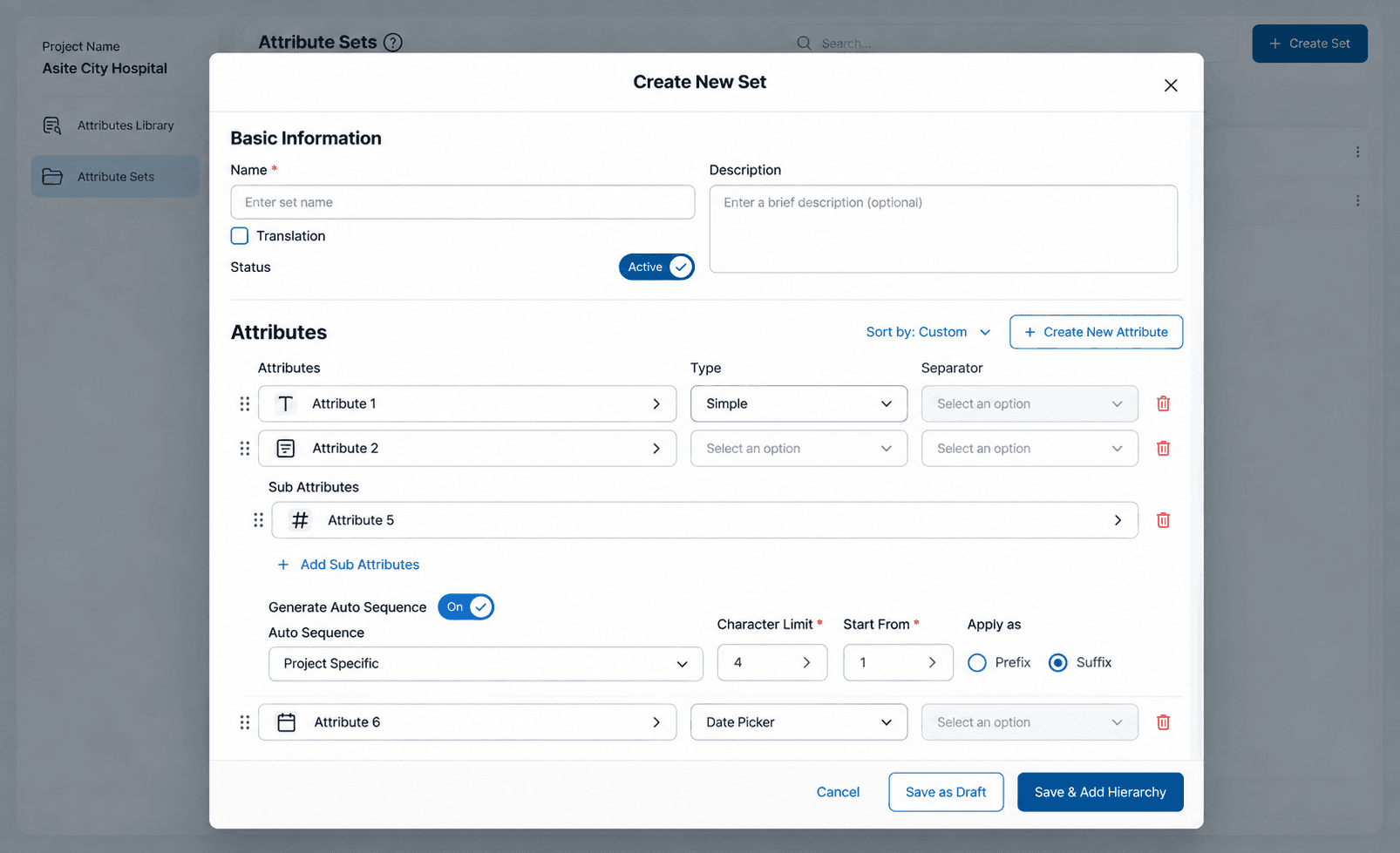
Reusable Attribute Sets
Attributes could be grouped into reusable sets, using a clearer drag-and-drop model and automatic sequencing to reduce repetitive configuration.
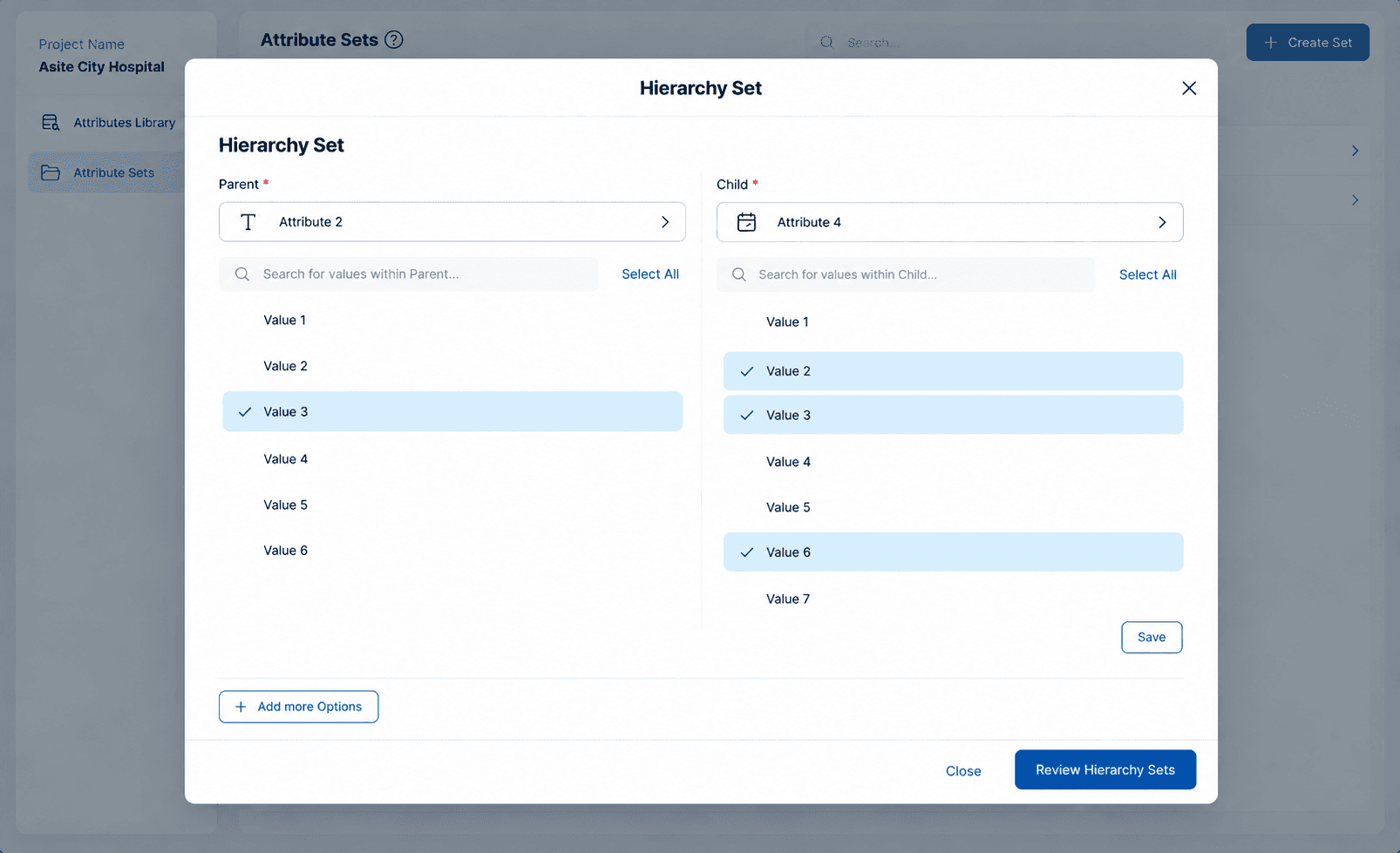
Visual hierarchy and inheritance
I redesigned hierarchy management to make parent-child relationships, inheritance and dependencies visible before users committed to changes.
Breaking inheritance cannot be reinstated.
A clearer publishing flow
Publishing became the final step in the configuration journey, allowing administrators to control where an attribute set became available and understand the scope of the change before publishing.
Beyond usability
Simplifying the experience without removing enterprise control.
The system still needed to support complex governance requirements. The design therefore had to make these rules understandable, rather than simply hide them.
Inheritance
Clear parent-child behaviour and inherited configuration.
Permissions
Controls over where changes could be made and by whom.
Translation
Support for configurable content across languages.
Publishing
Visibility of where configuration becomes available.
Auditability
Dependencies and consequences made visible.
Outcome
A clearer, more scalable configuration experience.
The redesign brought previously fragmented workflows into a connected system, making configuration easier to understand and manage while creating a more scalable foundation for attribute management, hierarchy and publishing.
Centralised
One reusable attribute library
Connected
A clear journey from creation to publishing
Scalable
Patterns designed around reuse, inheritance and governance
Validation
Testing the model, not just the interface.
I validated the redesigned workflows with internal teams and clients throughout the project, using prototypes to test whether users understood the relationship between attributes, sets, hierarchy and publishing. Feedback refined terminology, interaction patterns and the way dependencies were communicated before delivery.
Prototype review
“I can now see what will inherit before I make the change.”
Internal validation session · Hierarchy workflows
Reflection
The biggest design challenge wasn’t the interface. It was making the underlying system understandable.
This project reinforced the value of modelling relationships and system behaviours before designing screens. Once the underlying model became clearer, the interaction design became much easier to simplify.