Case study
Marketplace Ecosystem
Designing interconnected buyer and supplier experiences
I led the UX/UI design of a B2B marketplace spanning product discovery, catalogue management, checkout, fulfilment, orders, returns and supplier analytics — connecting buyer and supplier workflows into one coherent ecosystem.
Role
Lead Product Designer
Team
Product · Engineering · QA
Process
Discovery → Design → Validation → Delivery
Focus
Marketplace UX · Ecosystem Design · Commerce · Complex Workflows

The challenge
One marketplace, two very different experiences.
Buyers needed to discover products, compare options, understand pricing and fulfilment, place orders and manage returns.
Suppliers needed to create and maintain product catalogues, configure pricing and stock, process orders and returns, and understand marketplace performance.
The challenge was to design both sides as one connected product without making either experience feel like an extension of the other.
Ecosystem design
Marketplace · B2B Commerce · Buyer/Supplier · Enterprise SaaS
DISCOVERY
Understanding both sides before designing the transaction.
I worked with Product, Engineering and stakeholders to understand the needs, constraints and dependencies across buyer and supplier workflows. Rather than treating each side independently, I mapped how catalogue configuration, pricing, fulfilment and returns affected what users experienced on the opposite side.
This helped identify where the marketplace needed shared rules and where buyer and supplier experiences needed to remain deliberately different.

Design decision
We considered treating each fulfillment type as a separate checkout journey. Instead, I kept buyers within one cart and grouped items by supplier, surfacing fulfillment choices only when they became relevant.
This reduced fragmentation while still supporting the operational differences between Click & Collect and Standard Delivery.
Buyer ↔ Supplier relationship
Supplier configures
Bucket pricing
Return settings
Fulfilment options
Product specifications
Stock controls
Buyer experiences
Tiered pricing
Return eligibility
Delivery / Click & Collect
Product evaluation
Availability
ECOSYSTEM MAPPING
Before focusing on individual screens, I mapped how information and actions moved across the marketplace.
A decision made on the supplier side — such as pricing, fulfilment or returnability — directly affected what buyers saw and what they could do. Similarly, buyer actions created downstream requirements for suppliers around orders, collections and returns.
The goal was therefore not to optimise two separate products, but to design the connections between them.
Visual flow:
Catalogue
→ Marketplace
→ Discovery
→ Purchase
→ Fulfillment
Supplier:
Products
→ Pricing
→ Stock
→ Orders
→ Analytics
→ Order
→ Return
Buyer:
Search
→ Compare
→ Cart
→ Checkout
→ Tracking
→ Returns
KEY NEEDS
The experience needed to work across the whole transaction, not just checkout.
Product discovery
Buyers needed multiple ways to find the right product, including categories, keyword and SKU search, filtering and structured product information.
Confidence before purchase
Specifications, minimum order quantities, pack sizes, pricing tiers and returnability needed to be clear before users committed to an order.
Flexible fulfilment
The marketplace had to support different fulfilment methods, including Click & Collect and Standard Delivery, without making checkout difficult to understand.
Supplier control
Suppliers needed efficient ways to manage products, pricing, stock, orders, returns and performance without recreating the complexity of a full ERP.
These needs shifted the work from designing individual commerce screens to designing the complete marketplace journey.
BUYER EXPERIENCE
Designing the buyer journey from discovery to fulfillment.
Product discovery
Buyers needed multiple ways to find the right product, including categories, keyword and SKU search, filtering and structured product information.
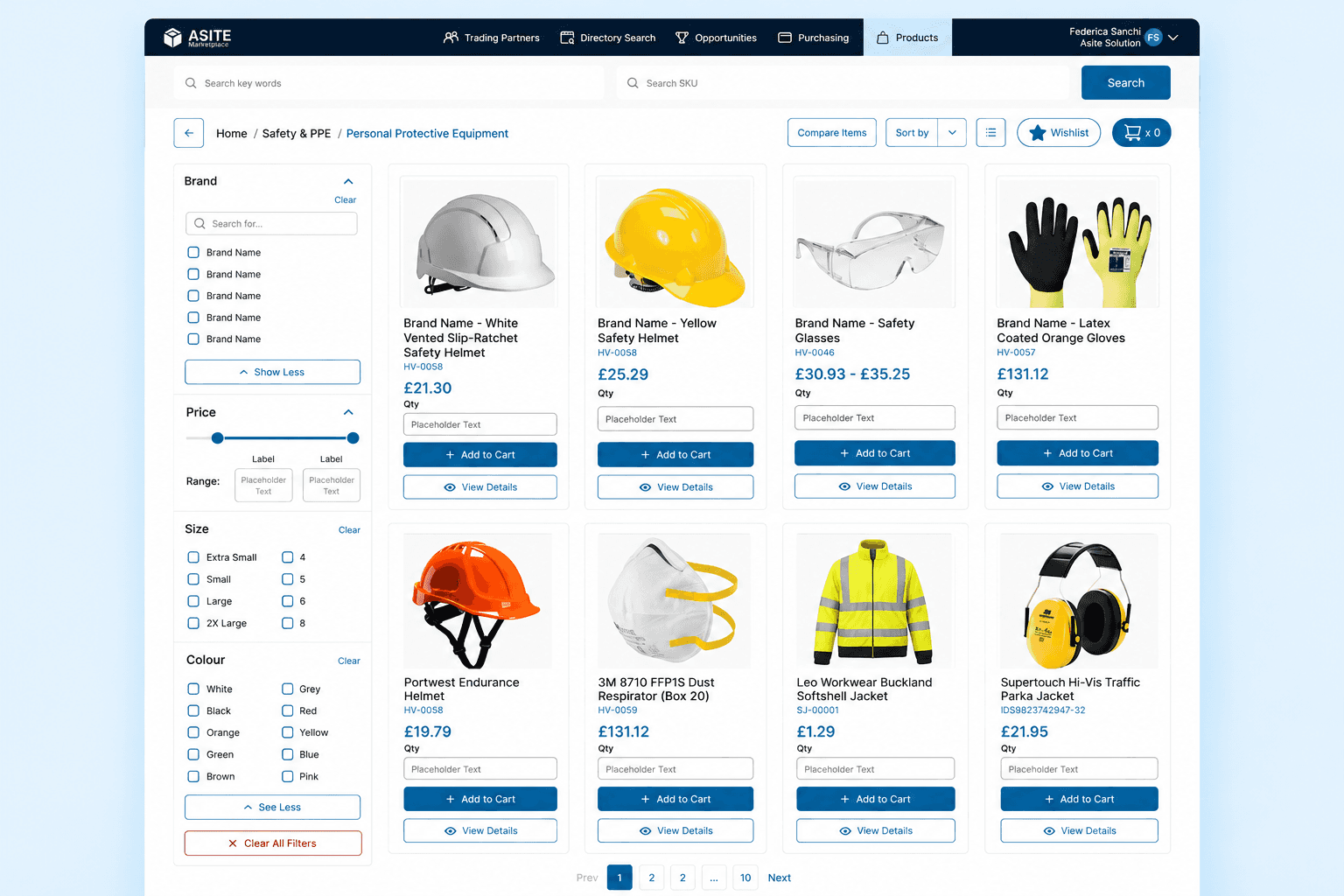
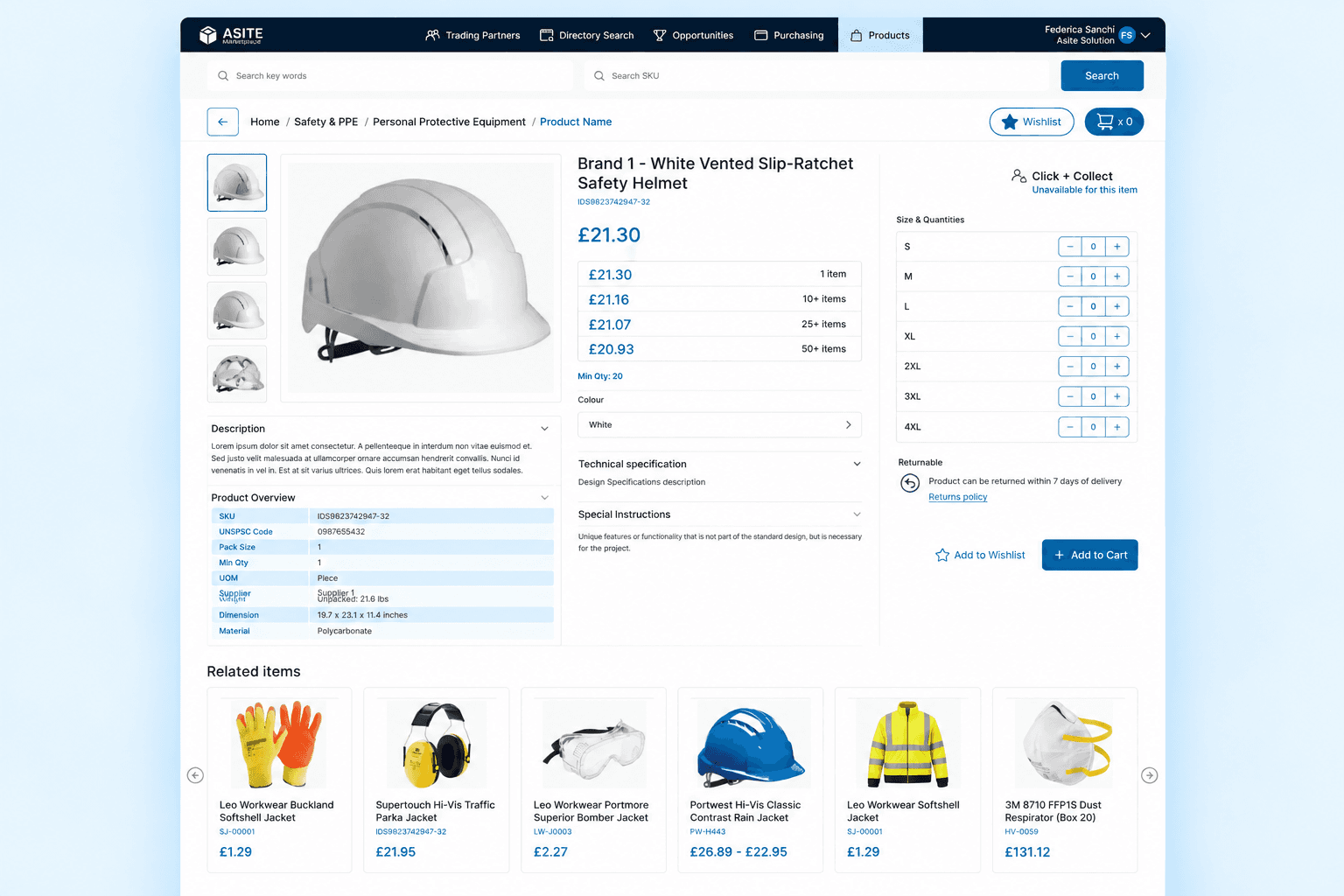
Evaluate
Product pages brought specifications, MOQ, pack size, pricing tiers, returnability and related information together so users could assess products before adding them to the cart.
Purchase
The cart grouped products by supplier and made fulfilment choices visible before checkout, helping users understand how different parts of an order would be delivered or collected.


Track
Order confirmation, history and order details gave buyers a clearer view of what they had purchased and the status of each order.
PRODUCT EVALUATION
Enterprise purchases are often driven by specifications rather than imagery alone.
I introduced product comparison so buyers could review key product information side by side before making a purchasing decision.
The aim was to support comparison without forcing users to repeatedly move between multiple product pages.

SUPPLIER EXPERIENCE
I focused the experience on the tasks that were specific to marketplace participation:
Catalogue management · Pricing · Orders · Returns · Performance
Catalogue
Making complex product setup manageable.
Creating marketplace products involved more than adding a title and price.
Suppliers needed to configure imagery, commodity mappings, bucket pricing, stock controls, specifications, variants and related products.
I structured product creation so information could be entered progressively and logically, while keeping the overall form understandable despite the number of configuration options.
The supplier product list also supported bulk updates to reduce the effort involved in maintaining larger catalogues.


ORDER MANAGEMENT
Giving suppliers the information they needed to fulfil each order.
Supplier order views needed to distinguish between Standard Delivery and Click & Collect while maintaining a consistent structure.
I designed the experience so fulfilment information was visible in context, helping suppliers understand what action was required without introducing unnecessary operational steps.
RETURNS MANAGEMENT
Designing the same journey from the opposite perspective.
Buyer return requests created corresponding tasks for suppliers.
The supplier experience included return settings, the ability to disable returns where appropriate, and workflows for reviewing and progressing return requests.
Designing both sides together helped ensure statuses and terminology remained consistent throughout the journey.


PERFORMANCE
Turning marketplace activity into useful insight.
Suppliers also needed visibility of how their products were performing.
I designed a Sales Overview covering metrics such as revenue, orders and average order value, alongside views of top customers, top-selling products and geographic performance.
The focus was on giving suppliers useful marketplace insight without overwhelming them with unnecessary reporting complexity.
CONNECTED EXPERIENCE
Every buyer decision had a supplier-side consequence.
The strongest design decisions came from treating buyer and supplier workflows as connected rather than independent.
You can show three paired examples visually:
Pricing
Supplier configures pricing tiers ↔ Buyer understands quantity-based pricing
Fulfillment
Supplier defines fulfillment context ↔ Buyer selects delivery or collection
Returns
Supplier defines return rules and manages requests ↔ Buyer understands eligibility and tracks progress
This relationship became a useful way of evaluating design decisions throughout the project: whenever something changed on one side, I considered the consequence on the other.
BEYOND THE INITIAL EXPERIENCE
Building patterns that could support a growing marketplace.
VALIDATION
Validating complete journeys, not individual screens.
I used stakeholder reviews, client feedback and workflow validation throughout the project, focusing on whether complete buyer and supplier journeys remained understandable as the marketplace expanded. Feedback informed terminology, information hierarchy and the sequencing of key actions across both sides of the product.
OUTCOME
A marketplace designed as an ecosystem, not a collection of features.
The work connected product discovery, purchasing, fulfilment and supplier operations into a more coherent marketplace experience.
By designing buyer and supplier journeys together, the product created a stronger foundation for future catalogue, procurement and marketplace capabilities.
Connected
Buyer and supplier workflows designed as one ecosystem.
Flexible
Commerce patterns supporting multiple fulfillment models
Scalable
Reusable foundations for catalogue, transactions and supplier growth
2
Interconnected user groups
2
Fulfillment models
6
Engineers
1-2
Product Designers
Reflection
The hardest part wasn’t designing commerce screens. It was designing the relationship between two sides of the marketplace.
This project reinforced that marketplace design is ecosystem design.
Improving one side of the experience often changes the information, actions and expectations on the other. The strongest solutions came from understanding those dependencies and designing both sides together rather than treating buyer and supplier journeys as separate products.